Physiotherapy for runners
Running too fast? Why the pace of every session may be costing you an injury
If you are 30 or 40, run regularly and something hurts every few months, the cause is rarely a "weak foot" or the wrong shoes. Far more often it is too high a pace on most of your runs, laid on a body that, after work, a night with a child and three coffees, has fewer resources to recover than it had at twenty.
Teho Sport team · physiotherapists and coaches from Trzebownisko near Rzeszów · updated 26 October 2026 to reflect the current state of research
You know the pattern. You head out for an "easy" 8 km, but by the second kilometre the watch shows race pace. You finish tired and pleased that you "did something". Two days later, the same again. After six weeks the Achilles, a knee or a shin starts to hurt and the familiar carousel begins: break, comeback, pain, break.
This article explains what happens in your body at that point, what the research of recent years says about it, and how to put your training in order so that running becomes something for years, not a cycle of injuries. The content is educational and does not replace a consultation with a physiotherapist or doctor.
Contents
- Key takeaways
- What happens in the body when every run is "all out"
- What the research says about running injuries
- An injury never has a single cause
- What you can do today
- Strength as insurance — and why supervision matters
- Exercise step by step: single-leg calf raises
- How we work at Teho Sport: physiotherapist or coach?
- FAQ: running injuries and training pace
- Summary
- Sources
What happens in the body when every run is "all out"
The heart and lungs adapt quickly. After a few weeks of regular running you feel you are "fit" and can push harder. The problem is that tendons, bones and fascia adapt more slowly, because they have a poorer blood supply and slower tissue turnover. Your fitness runs ahead while the connective tissues fall behind.
Fast running is not just a higher heart rate. At a higher pace the ground-reaction force on every stride grows, and with it the load on the Achilles tendon, the plantar fascia and the patellofemoral joint. The calves and glutes then work as the main engines of push-off, and the tendons as springs that store and return energy. A spring overloaded every day, with no time to rebuild, eventually starts to hurt.
Then there is recovery. A high-intensity session needs longer to recover from than an easy run. If every session is hard, you never reach full recovery and you start each run with a "debt". This is not about character or motivation. It is tissue biology, and it does not negotiate.
What the research says about running injuries
The largest study of recreational runners ever conducted says it plainly: an injury is made in a single session. The Garmin-RUNSAFE project (Frandsen, Bertelsen, Nielsen et al., BJSM 2025) followed 5,205 runners, mean age 46, for 18 months and nearly 590,000 sessions. 35% of them sustained an overuse injury. The risk rose clearly when a single run was more than 10% longer than the longest run of the previous 30 days, and rose further still for jumps above 30% and 100%. Interestingly, the week-to-week jump in volume did not predict injury, and the popular ACWR ratio did not behave the way the theory assumes. What matters is what you do today compared with what the body is used to.
Pace works the same way as distance. The authors point out that a sudden change in speed, surface or shoes makes other structures take on a load they are not ready for. For a runner over 30 that means, in practice: an "easy" run done at race pace is the same load spike for the tendons as a suddenly extended long run.
As for intensity distribution, a review of studies on recreational runners (Cruz-González and Arboleda-Serna, 2022) shows that the polarised model — roughly 80% of volume at low intensity and 20% at high — produces results over 2–10 km comparable with the threshold model, even though most of its kilometres are run easy. The earlier randomised trial by Muñoz et al. (2014) in 10 km runners showed an advantage for the polarised model in those who actually followed it. In fairness: direct evidence that intensity distribution alone lowers the injury count is still thin. But the mechanism is consistent with the load-spike data, and easy running does not cost you results, so you lose nothing.
And the skill of running slowly? Recreational runners often do their "easy" runs in zone 3 rather than zone 2, because zone 2 feels too slow to be worth anything. It is worth a lot. That is where capillary density, mitochondria and running economy are built, without the recovery cost that intervals carry.
An injury never has a single cause
Running too fast is an important factor, but not the only one. An umbrella review of systematic reviews (Correia et al., Journal of Sport and Health Science 2024) gathered 131 associations and showed that three groups of factors weigh most on injury risk: training characteristics, health and lifestyle, and body build and biomechanics. The authors stress the multifactorial nature of running injuries.
In practice, for a runner over 30 several things usually stack up:
- Load management: pace and distance jump from run to run, with no plan.
- Strength: the calves, glutes and quads cannot keep up with the running volume, and running on its own builds almost no strength.
- Stiffness and tissue tolerance: tendons used to a desk job suddenly get tens of thousands of strides a week.
- Mobility: limited ankle dorsiflexion or hip extension changes how you land.
- Technique: there is no single ideal, but a low cadence and a big overstride in front of the body increase the load on the knee.
- Sleep, stress, nutrition: low energy availability and poor sleep are documented risk factors, especially for bone injuries.
The strongest single predictor of the next injury is the previous one. That is why going back to running "once it stops hurting" almost always ends the same way. You have to find which of these elements failed and fix it, not just wait the pain out. That is what a physiotherapist-led return to sport after an injury is for.
What you can do today
- 1. Slow down on most runs. Run about 80% of your volume at a pace where you can comfortably speak in full sentences (heart-rate zone 2). If you cannot talk, you are running too fast. Save the hard efforts for 1–2 sessions a week and make the rest genuinely easy. The 80/20 split comes from research; the number of hard sessions is coaching practice.
- 2. Stop comparing paces. The fact that a friend runs 5 km in 20 minutes is not your training plan. Your pace comes from your thresholds, not from a Strava table. If you do not know your zones, an exercise test or a simple field test gives you more than months of guessing.
- 3. Don't look for the answer only in shoes or technique. Changing footwear, surface and running style at once is another load spike, not a reduction. There is no single universal technique. There are elements worth checking in a specific person, and that is work done on analysis, not intuition.
- 4. Build gradually, and look at the single session. In the light of the research, the "10% a week" rule matters less than "no run more than 10% longer than the longest of the past month". The same goes for pace: do not introduce a new, higher intensity and a new distance in the same week (coaching practice).
One more thing: you do not have to finish every run exhausted to make progress. For many people over thirty, the biggest training challenge is learning to run slowly.
Strength as insurance — and why supervision matters
Slower running reduces load spikes. Strength training raises how much load the tissue can take. The two work together.
The data here is interesting. The meta-analysis by Wu et al. (Sports Medicine 2024, 9 studies, about 1,900 runners) did not show that exercise programmes in general reduced running injuries. But when the authors separated out supervised programmes, the effect became significant: supervised strength training clearly reduced injury risk. The study by Desai et al. (Scandinavian Journal of Medicine & Science in Sports 2023) covered 433 recreational runners: those who, for 18 weeks, diligently did a 20-minute programme twice a week (single-leg squats, lunges, band walks, side planks, foot-arch work) had an 85% lower injury risk than the control group. The key word is "diligently". Across the whole group that trained "when it fitted", the difference disappeared — and since this was a comparative rather than randomised study, part of that effect may reflect who the people are that stick to a plan.
The conclusion is simple: not "strength helps runners", but "strength matched to the structure, done correctly and regularly, helps runners". Doing a few squats at home guarantees nothing on its own.
The choice of method depends on what is failing:
- Tendons (Achilles, plantar fascia, patellar tendon): heavy slow resistance training (HSR) and eccentric work, because a tendon adapts to a large load applied slowly.
- Hip and trunk stability: isometrics and single-leg exercises, because in running the glutes and deep trunk work as stabilisers, not as main engines.
- Power and spring stiffness: plyometrics introduced gradually, only once the strength base is built.
- Calf muscles: they are the main engine of push-off, so their strength and endurance are a condition, not an extra. More in our article Calf training — a fad or the foundation of fitness?
This is not a list of "exercises for runners" but a rule for choosing them. Which part applies to you comes from an assessment, not from an article.
Exercise step by step: single-leg calf raises
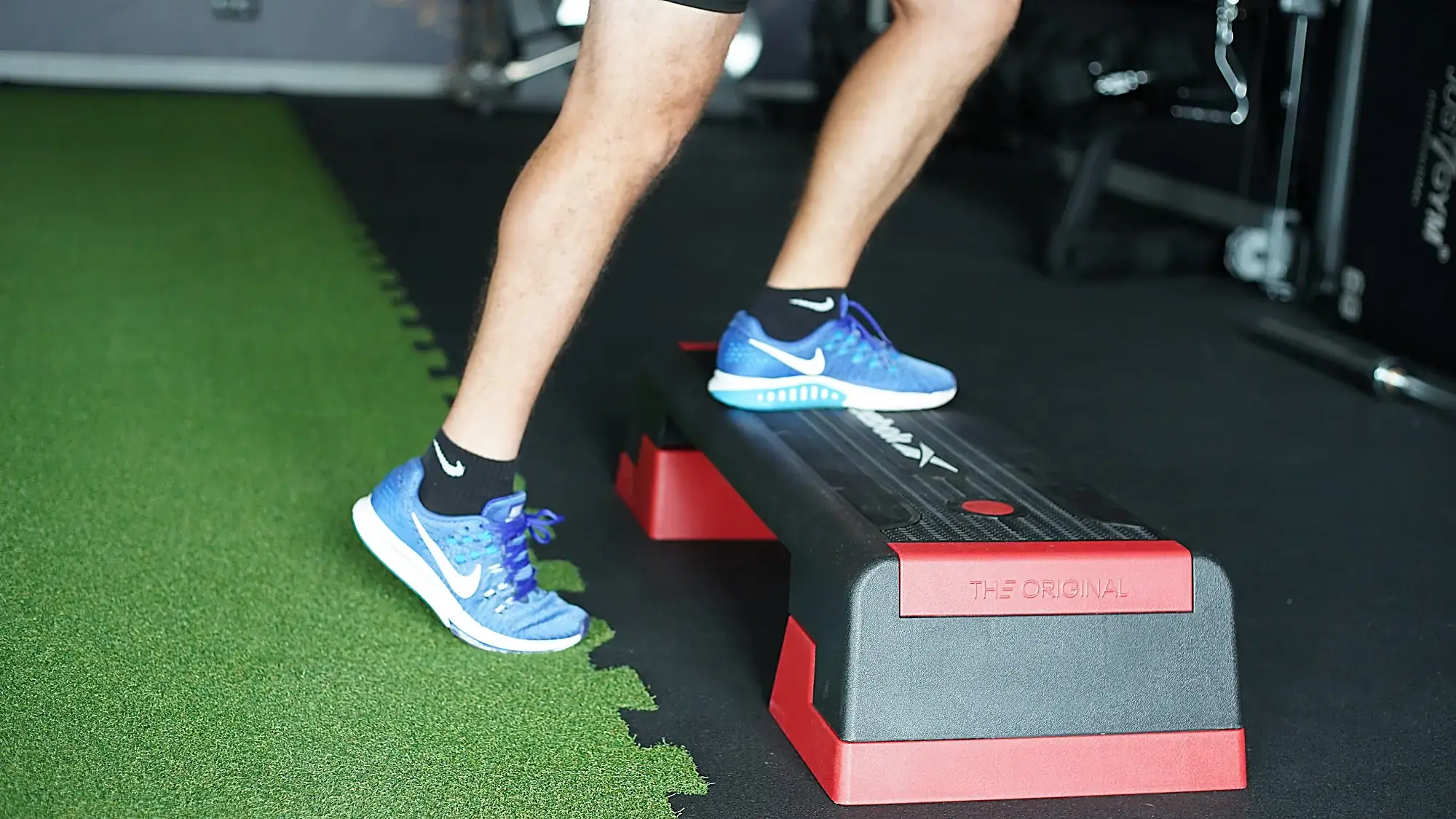
In running the calf muscles are the main engine of push-off, and the Achilles tendon transfers their work to the foot. This exercise builds both, and at the same time shows whether you have any strength "reserve" for running at all. In the Teho Sport training room we do it on an aerobic step or on the edge of a stair.
- 1. Position: stand on the edge of a step on one leg, heel hanging in the air. The toes of the other foot lightly touch a wall or rail for balance only, not to take weight.
- 2. Movement: slowly lift the heel as high as you can (2 seconds up), hold for a second, lower below the level of the step (3 seconds down). The tempo should be slow and controlled, no bouncing.
- 3. Starting dose (clinical practice): 3 sets of 10–12 reps per leg, 3 times a week. When 12 reps feel easy, add a weighted backpack or a dumbbell in the hand on the working side, rather than adding reps.
- 4. How to judge whether the load is right: pain up to 3 on a 0–10 scale during the exercise is acceptable if it settles by the next morning. Higher pain, pain that grows set by set or is worse in the morning is a signal to reduce the load or the range. A difference of more than 2–3 reps between legs is a reason to see a physiotherapist.
The plan and progression are set individually, especially after a previous Achilles tendon injury.
How we work at Teho Sport: physiotherapist or coach?
The answer depends on where you are, not on who is "better". At Teho Sport in Trzebownisko near Rzeszów the physiotherapist and the coach work on the same runner, just from different sides.
See the physiotherapist first if:
- something hurts now, or hurt in recent months and has come back,
- you have had an injury and do not know whether it is really healed or has just stopped hurting,
- you want to know which element is failing: strength, mobility, tendon tolerance, the way you land.
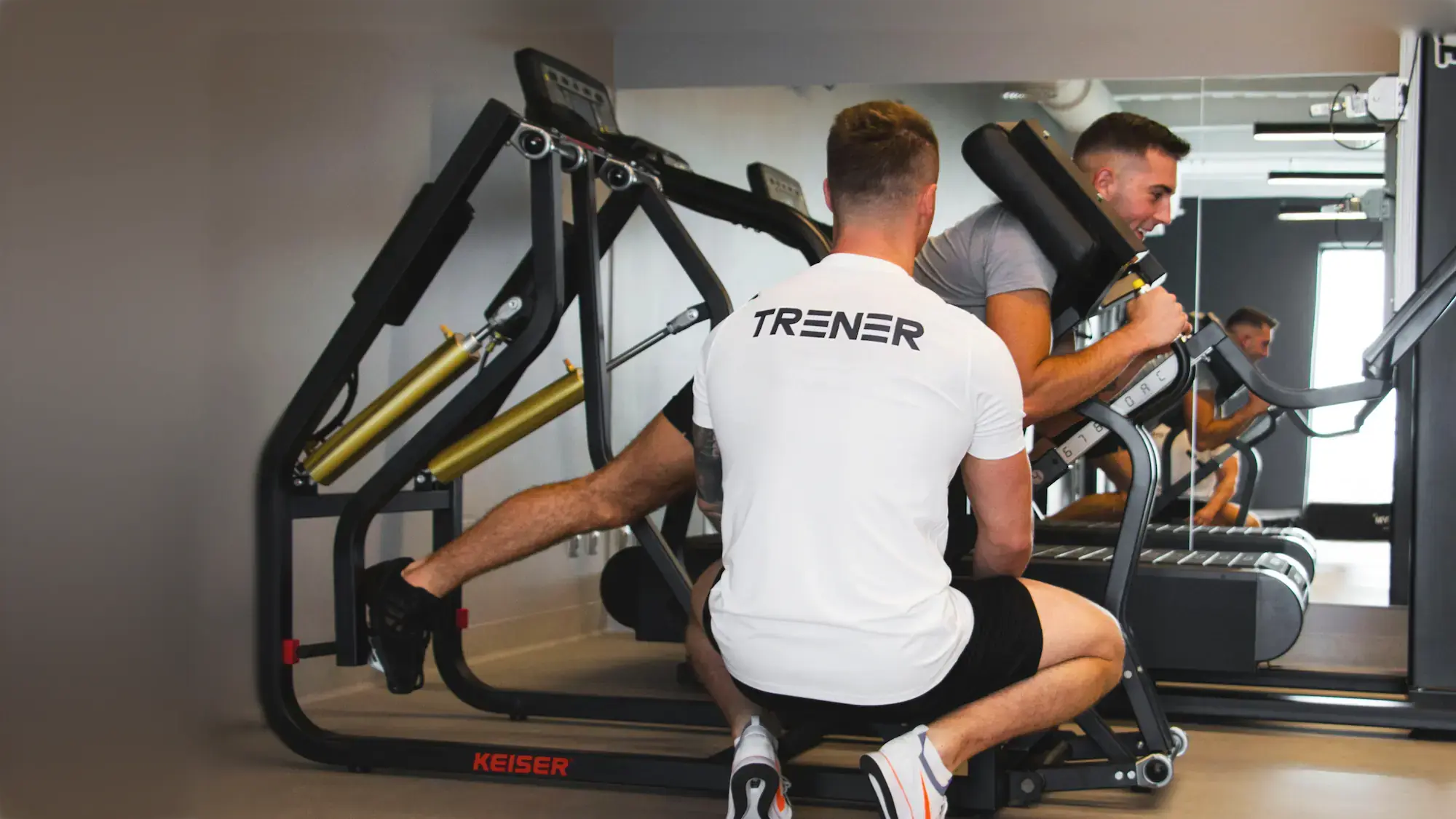
The physiotherapist examines, measures and makes a functional diagnosis. They check calf and glute strength, ranges of motion, the tendon's response to load, cadence and foot strike. On that basis they match the method to the structure: HSR and eccentrics for a tendon, isometrics for stability, plyometrics for springiness. You get not a list of exercises from the internet, but a plan for your tissue and your pain. That is what sports physiotherapy at Teho Sport looks like.
See the coach if:
- nothing hurts, but you feel you train chaotically and without progress,
- you cannot run slowly, or you do not know your heart-rate zones,
- you want someone to plan the weeks, distribute the intensity and watch the load spikes for you.
The coach sets the intensity distribution, matches the volume to your life rather than to a textbook, and runs the strength training in a way that gets it actually done rather than merely planned. That is exactly the supervision that, in the studies, made the difference between "no effect" and "significantly fewer injuries". At Teho Sport this happens through personal training or strength and conditioning.
The best scenario is both. The physiotherapist establishes where your weak point is and what work is needed. The coach weaves it into the weekly plan and makes sure the running does not undo what the gym builds. One person sees your tissues, the other your calendar, and you get one coherent system instead of two conflicting pieces of advice — under one roof, without telling your story twice.
FAQ: running injuries and training pace
How do I check whether I'm running too fast? If you cannot speak in full sentences on an "easy" run, you are running too fast. Most sessions should sit in heart-rate zone 2.
Does slow running make any progress at all? Yes. Low intensity is where the aerobic base and running economy are built, and studies in recreational runners show results from the 80/20 model comparable to continuous threshold running — at a lower recovery cost.
Does the 10%-a-week rule still apply? In the largest study of recreational runners, weekly jumps did not predict injury. What counted was a single run more than 10% longer than the longest of the past 30 days.
How many hard running sessions a week? In coaching practice, 1–2 intense sessions a week are enough for a recreational runner; the rest easy.
Does strength training protect against running injuries? Yes, provided it is done regularly and correctly. The 2024 meta-analysis found an effect only in supervised programmes.
When should I see a physiotherapist, and when a coach? The physiotherapist when something hurts or you are returning from an injury. The coach when nothing hurts but training is chaotic and you do not know your zones.
Will new shoes solve my injury problem? A change of shoes is another change of load, not a reduction. There is no evidence that one shoe model prevents injuries in everyone.
Where near Rzeszów can I find a physiotherapist for runners? At Teho Sport in Trzebownisko, right at the northern edge of Rzeszów — sports physiotherapy and personal training under one roof.
Summary
Running after thirty does not call for less ambition. It calls for better dosing. Most runs easy, load spikes under control, strength matched to what is failing in your body, and someone who looks at the whole from the outside.
If you are coming back from an injury or feel the pain is "always somewhere", book a runner's functional assessment with a physiotherapist at Teho Sport: +48 513 093 320. If nothing hurts but every run ends as a fight for pace, a coach will help you set your zones and build a plan in which slow running stops being a failure and becomes a tool — reception: +48 17 870 04 44.
And you? Can you run genuinely slowly, or does every run end as a fight for pace?
Teho Sport, Trzebownisko 928b, right at the northern edge of Rzeszów. The content is educational and does not replace a consultation with a physiotherapist or doctor. The exercise and loading plan is set individually.
Sources and evidence base
- Frandsen J.S.B., Bertelsen M.L., Nielsen R.Ø. et al. How much running is too much? Identifying high-risk running sessions in a 5200-person cohort study. British Journal of Sports Medicine 2025;59(17):1203–1210. DOI 10.1136/bjsports-2024-109380. Prospective cohort study (Garmin-RUNSAFE).
- Correia C.K. et al. Risk factors for running-related injuries: An umbrella systematic review. Journal of Sport and Health Science 2024. DOI 10.1016/j.jshs.2024.04.011. Umbrella review of systematic reviews.
- Wu H., Brooke-Wavell K., Fong D.T.P., Paquette M.R., Blagrove R.C. Do exercise-based prevention programs reduce injury in endurance runners? A systematic review and meta-analysis. Sports Medicine 2024;54(5):1249–1267. DOI 10.1007/s40279-024-01993-7. Meta-analysis of randomised trials.
- Desai P., Jungmalm J., Börjesson M., Karlsson J., Grau S. Effectiveness of an 18-week general strength and foam-rolling intervention on running-related injuries in recreational runners. Scandinavian Journal of Medicine & Science in Sports 2023;33(5):766–775. DOI 10.1111/sms.14313. Prospective comparative (non-randomised) study.
- Muñoz I. et al. Does polarized training improve performance in recreational runners? International Journal of Sports Physiology and Performance 2014;9(2):265–272. PubMed 23752040. Randomised trial.
- Cruz-González, Arboleda-Serna. Training intensity distribution on running time in amateur endurance runners: a scoping review. Revista de Investigación e Innovación en Ciencias de la Salud 2022;4(2). Redalyc. Scoping review.
- Silbernagel K.G. et al. Continued sports activity, using a pain-monitoring model, during rehabilitation in patients with Achilles tendinopathy: RCT. American Journal of Sports Medicine 2007;35(6):897–906. Source of the "pain up to 3/10 that settles by morning" rule.
- Teho Sport — sports physiotherapy · return to sport after an injury · personal training