Physiotherapy and strength & conditioning
Spine and Hip Yoga — why train the hips when it is the back that hurts?
In the morning you bend down for your shoes and, for a split second, wait to see whether your lower back will “give”. Forty minutes in the car, eight hours at a desk, then the sofa. Your hips bent at the same angle all day, and by the evening your back is as stiff as after a long flight.
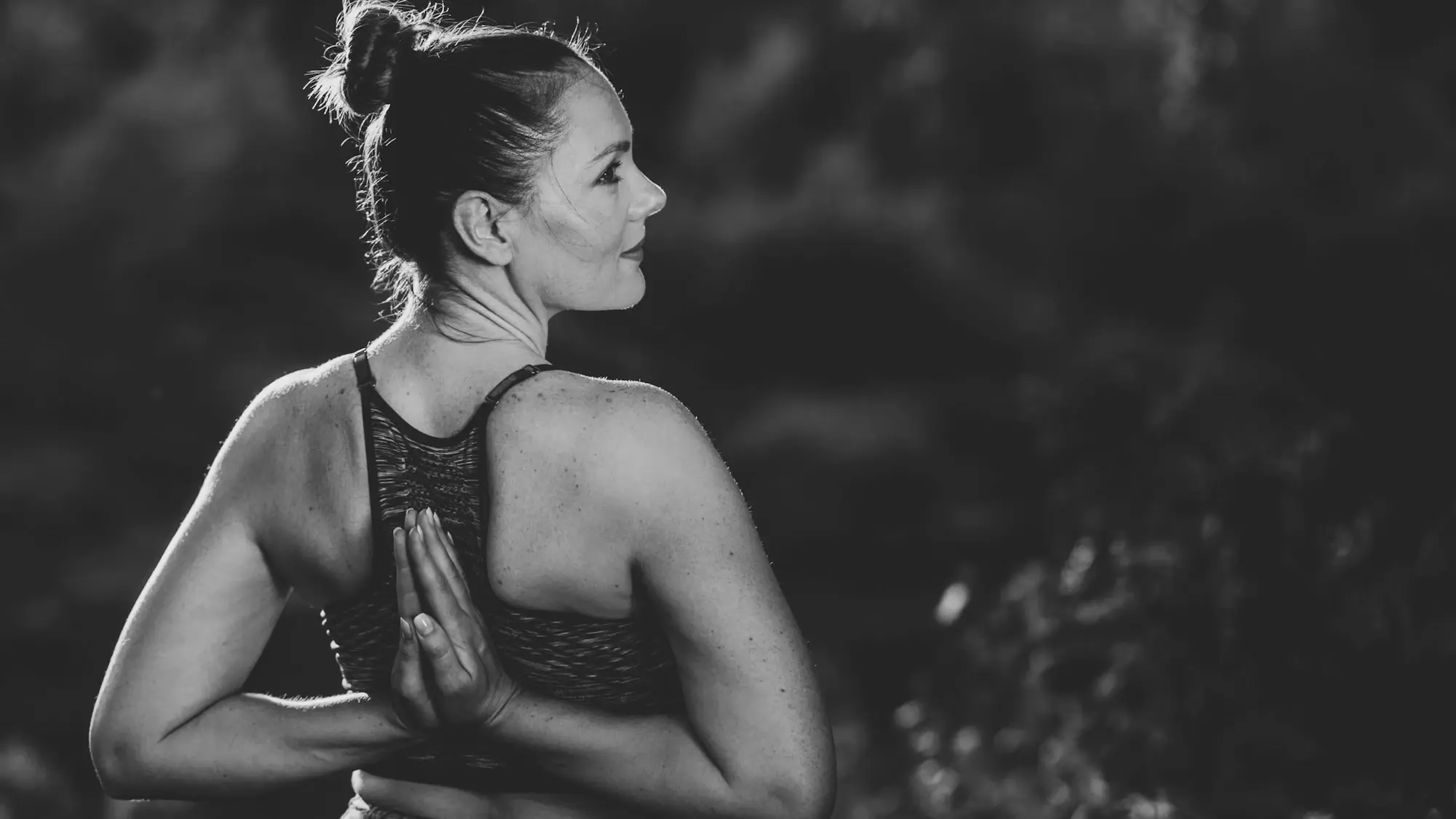
Led by: Joanna Konopczyńska, Iyengar yoga teacher · Reviewed by: the Teho Sport physiotherapy team
This is not about age. It is about stimulus: after thirty the body gets fewer and fewer chances to move through its full range, and it answers the only way it can — by shortening tissues and stiffening. That is why the Spine and Hip Yoga class at Teho Sport is not “yoga for the back”. It is work on one system in which the hips and the lumbar spine share movement — and in which whatever the hip does not do, the spine has to.
Contents
Hips and lower back work as one system
Pick something up off the floor. If you do it well, you fold at the hips and your back stays almost straight: the glutes and hamstrings do the work, while the deep abdominal and back muscles hold the lumbar spine still, like a corset. At the front of the hip sit the hip flexors, which are shortened all day when you sit. When the hip lacks its full range of motion, bending and twisting shift into the lumbar spine — and it is not built for that.
A 2024 systematic review (BMC Musculoskeletal Disorders) showed that in people with chronic low back pain it is not only the trunk that works worse: reduced range of motion and reduced strength show up in the hips too, and hip internal rotation is the movement most often restricted. The research does not settle whether a stiff hip causes the pain or the pain stiffens the hip. It does say clearly that low back pain usually has several causes at once — too little strength, stiff tissues, a small range of motion, long hours of sitting, movement habits — and that the hips belong in the plan permanently, not for a single course of treatment.
What the research says about yoga and the spine
We do not promise miracles. We show what came out of the research of recent years.
Less pain, fewer painkillers. In a JAMA Network Open study (2024), 140 adults with chronic low back pain (mean age 48) attended one 60-minute yoga class a week for 12 weeks; a second group waited and served as the comparison. After 12 weeks pain had dropped by an average of 1.5 points on a 0–10 scale, after six months by 2.3 points, and back function had improved. At the start 74% of the participants were taking pain medication; six months later it was about 30%. One session a week — exactly what you have in the Teho Sport schedule.
Yoga versus physiotherapy. In an Annals of Internal Medicine study (320 people), a 12-week yoga programme designed for back pain produced the same effect as 15 physiotherapy visits, and the improvement held for a year. The authors' caveat: this means yoga led by an experienced teacher and matched to the problem, not any class from the internet. That is why the Teho Sport class is taught by someone with many years of practice, who will show you the version of each pose that fits your body.
Guidelines. In its first guideline for chronic low back pain (2023), the World Health Organization recommends regular, supervised exercise programmes — including strength training, stretching, yoga and pilates — and stresses that back pain calls for several measures at once, not one method.
What an hour of Spine and Hip Yoga looks like
The class runs on Fridays at 18:00 and lasts 75 minutes. It is led by Joanna Konopczyńska: practising since 2006, she completed a three-year Iyengar yoga teacher training and a year-long course in yoga therapy with Katarzyna Pilorz, as well as courses in fascial yoga and breath therapy; she is a member of the Iyengar Yoga Association of Poland. The Iyengar method means precise alignment, longer holds and props — blocks, straps and blankets, which the club provides. You start from the version you can do today, not the one from Instagram.
What exactly you train in this class:
- The front of the hips and the back of the thighs — what sitting shortens. Long, calm poses (supported lunges, forward bends with a strap) give the tissues time to lengthen. A quick tug changes nothing; what counts is time spent in the pose.
- Hip rotation — the movement most often restricted in people with back pain. Seated and lying poses in which you turn the thigh inwards and outwards while making sure the lower back does not “help”.
- The muscles that hold the trunk and pelvis — standing poses held for 30–60 seconds. The muscles contract without moving, exactly the way they work when you carry shopping or stand in a queue. The deep abdominal, back and lateral hip muscles learn to keep the spine in place while the hip moves.
- The upper back — supported twists and backbends, so that you rotate and extend where the spine has the range for it (between the shoulder blades) rather than in the lumbar spine, which does not like it.
Yoga builds control and postural endurance. It does not build muscle mass and does not improve fitness — and it does not pretend to. Other rooms in the same building are for that.
Who it is for, and why
You work at a desk. Your hips spend 10–12 hours a day in flexion. You need a regular stimulus in the other direction: extension, rotation, a full forward fold. One session a week is the minimum at which the 2024 study showed an effect.
You lift weights. The squat, deadlift and lunge need range at the hip; when it is missing, the movement escapes into the lumbar spine and that is what takes the load. Yoga will not replace the weights, but it gives you range you will use under the bar in the gym.
You play squash, tennis or badminton. A lunge for the ball is a deep lunge, a stroke is a rotation from the hip. When the hip does not rotate, you rotate with the trunk instead. Working on the hips is an investment in getting up from a chair after a squash, tennis or badminton match without planning it.
You are 50+. Joint range of motion shrinks year by year if you do not use it. Props mean you need no “base” to start — and if you prefer one-to-one work, there is health training 40+.
You have never done yoga. You do not need to be flexible. Come fifteen minutes early and tell the teacher it is your first time.
Yoga is one piece. The rest is under the same roof
The WHO says it plainly: back pain needs several interventions at once. At Teho Sport you put them together from one membership and one building.
- Range of motion and pelvic control → Spine and Hip Yoga. Work on what the gym will not do: hip rotation and extension, long-held poses.
- Strength of the hip and trunk extensors → the gym, Body Pump, Abs, Glutes, Thighs. Research shows an effect from both strengthening and stretching the hips; yoga gives range, weights give the strength that keeps it.
- Carry-over into everyday movement → Functional Training. Lifting, carrying, changing direction — the hip does the moving, the lower back stays stable, and the coach watches the technique.
- A gentle way back after a break → Healthy Spine (Tuesdays and Thursdays at 19:30). Trunk stabilisation and thoracic mobility at a moderate pace; the natural second session of the week alongside yoga.
- Rotation and lunging in play → squash, tennis, badminton. The range built on the mat is used on the court; after a match, yoga is recovery for the hips.
- Pain, injury, a diagnosis → physiotherapy: assessment, manual therapy, medical training, spine rehabilitation. Assessment and treatment first, then the decision about which group classes are safe.
Physiotherapist or coach? It depends where you start. If it hurts, the pain radiates into the leg, there was an injury or you have a diagnosis, you start with a consultation with the physiotherapy team: the physiotherapist checks what is restricted and tells you whether yoga is the right choice now or whether medical training comes first. If it does not hurt, you go straight to the class, and after a few weeks a coach will show you how to use the new range with a weight in your hands. At Teho Sport one flows into the other, in the same building.
A sample week for a desk worker, 38, no injury:
- Monday — Body Pump at 17:30, or the gym on your own: squat, hip thrust, rows.
- Tuesday or Thursday — Healthy Spine at 19:30, or Functional Training at 18:30.
- Friday — Spine and Hip Yoga at 18:00, and an hour of squash with a friend at the weekend.
Three hours. Strength, range, movement in play. Plus short breaks from sitting during the day — no class will undo ten hours in one position.
Frequently asked questions
My back hurts. Can I come to yoga? For chronic, non-specific low back pain the research shows benefits. For acute pain, sciatica, numbness in the leg or after an injury — a consultation with the Teho Sport physiotherapy team first.
How many times a week for an effect? In the 2024 study one session a week for 12 weeks produced an effect. A second session — Healthy Spine on Tuesday or Thursday, for example — speeds up progress.
Will yoga replace the gym? No, and that is not the goal. Yoga gives range and control, the gym gives strength. People who do both usually notice their squat and deadlift getting deeper and cleaner.
I am as stiff as a board. Will I manage? Yes. That is exactly what the blocks and straps are for. You start from the version you can do today.
How does Iyengar yoga differ from other styles? Precise alignment, longer holds and systematic work with props. Less “flow”, more control — which is why it suits work on the hips and spine so well.
When is the class, and do I need to sign up? Fridays at 18:00, 75 minutes. For yoga — unlike the other group classes — you sign up by phone at reception: 17 870 04 44. You come in on a membership or a single entry; partner cards are accepted.
Sign up for Spine and Hip Yoga — Friday 18:00: reception 17 870 04 44 · class page. In pain or injured? Book a consultation with the physiotherapy team: +48 513 093 320.
Teho Sport, Trzebownisko 928b, right at the northern edge of Rzeszów. Yoga is included in the membership, sign-up by phone; the other group classes need no sign-up. We accept MultiSport, FitProfit, Medicover Sport and PZU Sport cards.
The content of this article is educational and does not replace a consultation with a doctor or physiotherapist. If the pain radiates into the leg, comes with numbness or appeared after an injury, see a specialist before starting the class.
Sources and evidence base
- Tankha H et al. Effectiveness of Virtual Yoga for Chronic Low Back Pain: A Randomized Clinical Trial. JAMA Network Open 2024;7(11):e2442339
- Saper RB et al. Yoga, Physical Therapy, or Education for Chronic Low Back Pain: A Randomized Noninferiority Trial. Annals of Internal Medicine 2017;167(2):85–94
- WHO. Guideline for non-surgical management of chronic primary low back pain in adults in primary and community care settings. Geneva 2023
- BMC Musculoskeletal Disorders 2024 — systematic review of hip biomechanics in patients with low back pain (range of motion, strength, internal rotation)
- Teho Sport — Spine and Hip Yoga, class page
- Teho Sport — Joanna Konopczyńska's profile · class schedule