Strength training
MiniGroups for women. Strength you will use for years
Strength isn't about biceps. It's carrying the shopping up to the third floor without a second thought. Lifting a suitcase onto the overhead rack, holding a child for longer than five minutes, and still having energy for the evening after a whole day on your feet.
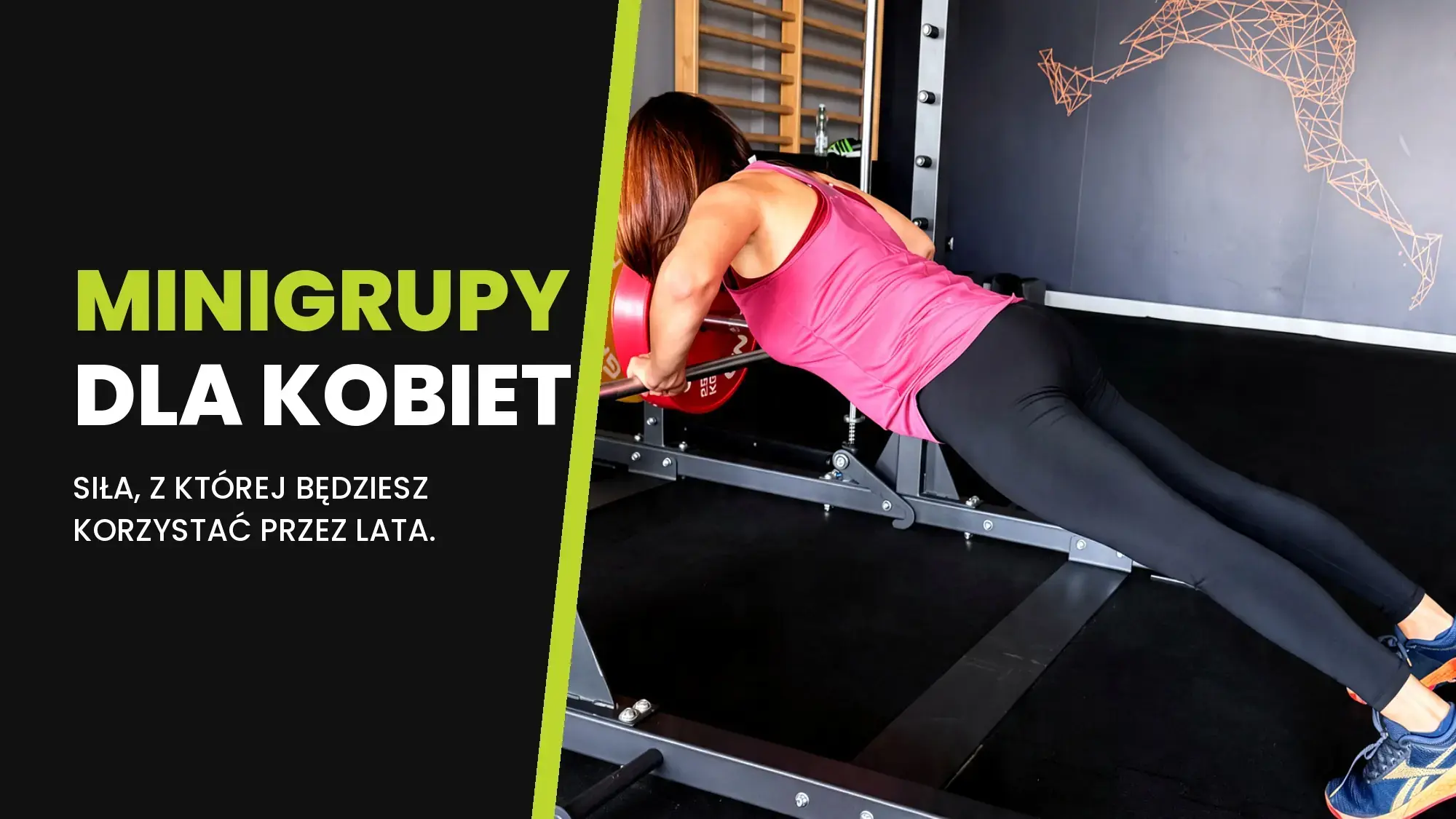
All of that is done by muscle — and muscle is the first thing that quietly starts to disappear.
The good news: the process can be stopped, and even reversed. At any age. And you don't need an hour a day or to be “fit” to start.
What happens to muscle after thirty
From around age 30 the body starts losing muscle mass — on average 3–8% per decade, and after sixty the process speeds up (Volpi et al., Curr Opin Clin Nutr Metab Care 2004). Doctors call it sarcopenia. You don't feel it from one day to the next — it's more the moment the shopping bag feels “heavier than it used to”.
For women there is a second process: around the menopause, falling oestrogen accelerates the loss of bone density — in the few years after menopause a woman can lose up to 20% of her bone mass (NIH, Osteoporosis Overview). And the most effective non-drug way to strengthen bone is precisely strength training: in the LIFTMOR trial it improved spine and femoral-neck bone density in postmenopausal women (Watson et al., J Bone Miner Res 2018).
Muscle is also metabolism. It is the body's largest “store” of sugar — the more muscle mass, the better your insulin sensitivity and the more stable your weight. That is why the WHO recommends muscle-strengthening training for all adults at least twice a week — alongside ordinary movement.
Why you need strength — today and in twenty years
The muscle you build now is capital you will draw on for decades. A large meta-analysis in the British Journal of Sports Medicine showed that as little as 30–60 minutes of strength training a week is linked to a 10–17% lower risk of death, heart disease, diabetes and cancer (Momma et al., BJSM 2022). That isn't elite sport — it's two calm sessions a week.
What does that mean in practice?
- Today: a straighter back at the desk, fewer twinges when you bend, more energy in the evening and better sleep.
- In 10 years: a stable weight and a metabolism that doesn't slow down as fast, and a gentler passage through the menopause.
- In 20–30 years: independence. Leg strength and balance are the best insurance against falls and fractures — the things that most often take away independence after seventy.
Then there's your head: in study after study, strength training reduces symptoms of anxiety and low mood (Gordon et al., JAMA Psychiatry 2018) — we wrote more about it in women's strength training and stress. Many women simply say: “it's my hour just for me”.
Why a MiniGroup
Most women don't need motivation — they need a plan and someone to lead the way at the start. That is exactly what a MiniGroup gives you:
- A plan made for you. The coach builds the session around your level, health and goal. You walk in and know what to do — from the first minute.
- Technique under a watchful eye. With a handful of people, the coach sees every rep. You learn safely, without guessing.
- A fixed slot. A booked hour and a group that is waiting for you do what no app does: they build consistency. And results come from consistency, not from one-off bursts.
- Your pace, shared energy. You train alongside women who started exactly where you are. Each works at her own load, but it's easier not to give up when someone next to you is fighting for hers too.
A small group combines the best of personal training (the coach's attention, a plan) with the best of a group (energy, company, a lower price).
How to start
You don't have to be “fit”, you don't have to know anything, and you don't have to lift heavy right away. Come as you are — we'll take care of the rest together. The first session is simply a meeting: we check where you stand and set up a starting plan.
And if you'd rather train as a pair or 1:1 with a coach — give us a call. We'll talk about your goal and choose the best form of training: with a strength and conditioning coach or a physiotherapist, for example as health training 40+.
Your muscles will be with you for the rest of your life. It's worth having more of them.
Write to us and reserve your place in a MiniGroup — places per group are limited. Current slots are in the MiniGroup schedule.
Sources and evidence base
- Volpi et al. 2004 — muscle loss with age (Curr Opin Clin Nutr Metab Care)
- NIH — osteoporosis (NIAMS, Osteoporosis Overview)
- Watson et al. 2018 — the LIFTMOR trial (J Bone Miner Res)
- WHO 2020 — guidelines on physical activity and sedentary behaviour
- Momma et al. 2022 — strength training and mortality (Br J Sports Med)
- Gordon et al. 2018 — strength training and mood (JAMA Psychiatry)